
Uro-Gard gives your clinical team a viable external alternative for male patients who would otherwise be managed with a Foley catheter or absorbent brief.
The clinical and financial case
Catheter-associated urinary tract infections remain among the most common and most preventable healthcare-associated infections, and CMS ties a portion of hospital payment to performance.
Uro-Gard does not treat infection. It addresses the upstream cause: indwelling catheter use in patients who could be managed externally instead. External catheters avoid the urethral trauma and biofilm formation that drive most catheter-associated infections, and they are a guideline-supported alternative where clinically appropriate.
Under the CMS Hospital-Acquired Condition Reduction Program, hospitals in the worst-performing quartile lose 1% of total Medicare payments. For most facilities, that penalty exposure alone exceeds the annual supply cost of an external catheter program.
Sources: CDC/NHSN healthcare-associated infection surveillance data; peer-reviewed CAUTI cost-of-care studies; CMS Hospital-Acquired Condition Reduction Program. Figures describe the CAUTI category generally and are not claims of measured Uro-Gard performance.
The device
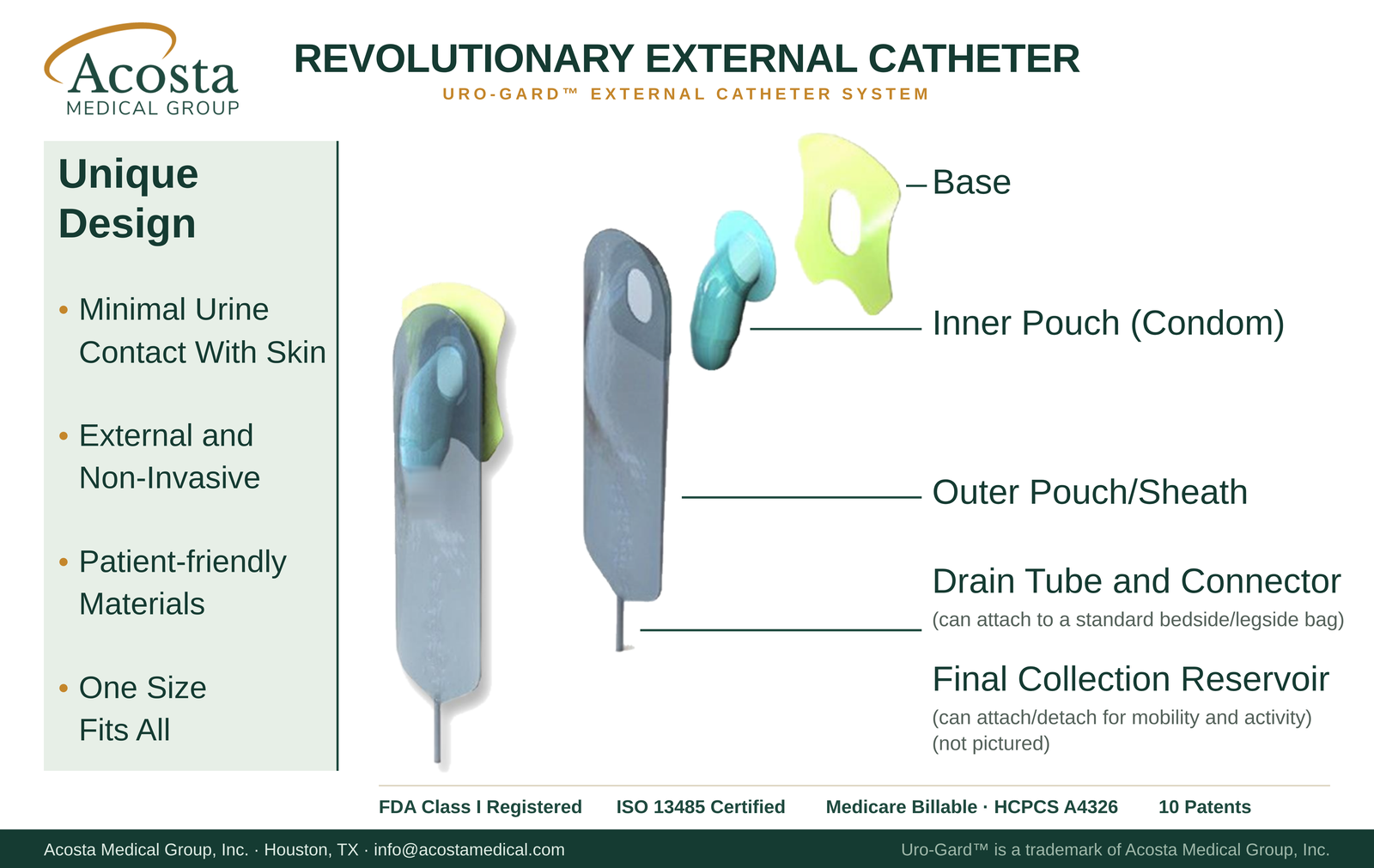
Competing external catheters are single-sheath devices that manage flow. Uro-Gard is built to direct urine away from the skin and hold it there.
Why it works for your facility
Care settings
The reimbursement pathway differs by setting. Knowing which applies to you determines how the product is purchased.
| Setting | How it is supplied | Who decides |
|---|---|---|
| Acute care hospital | Bundled into the MS-DRG case rate; purchased from facility supply budget | Value Analysis Committee, Infection Prevention, CNO |
| Inpatient rehab / LTACH | Bundled into the IRF-PPS per-discharge rate | Nursing leadership, rehab medical director |
| Skilled nursing | Bundled into SNF-PPS per diem (Part A) or Medicaid per diem | Director of Nursing, Administrator, corporate VAC |
| Assisted living | Largely private pay; residents may qualify under Part B (A4326) | Executive Director, wellness director |
| Home health | Part B durable medical equipment benefit, or agency supply | Agency clinical leadership, WOC nurses |
| VA / DoD | Federal Supply Schedule; TAA-compliant domestic manufacture | Prosthetics chief, contracting officer |
In acute care, inpatient rehabilitation, and Medicare Part A skilled nursing, supplies are bundled into the facility's payment. The purchase is a value-analysis and budget decision won on infection avoidance and nursing time, not on billing. HCPCS A4326 generates separate, itemized reimbursement primarily in home-based settings, which covers home health, eligible assisted living residents, and patients discharged to home.
Procurement
Purchase directly from Acosta Medical Group with facility-level terms.
Through your existing medical-surgical or DME distribution partner.
Group purchasing agreements with pre-negotiated pricing and terms.
Federal Supply Schedule and Defense Health Agency procurement.
Facility evaluation
We supply the product, the clinical education, and the in-servicing. Your team runs it with the patients you select. At the end you have your own data, not ours.
Typical evaluations run 8 to 20 patients. We will help you scope it to your census and staffing.
We will never share your information. Submitting this form does not create a purchase obligation.
Resources
Everything a value analysis committee, infection prevention team, or supply chain lead typically asks for.
Four-component system overview, sizing range, materials, application and removal instructions, and compatible drainage bags.
RequestFDA Class I registration, ISO 13485 certification, TAA compliance statement, and HCPCS A4326 coding guidance with LCD L33803 reference.
RequestCAUTI cost-avoidance framework, per-facility volume model, comparison against indwelling catheter and absorbent care, and evaluation protocol.
Request